



Michigan First Time Home Buyer Programs: Get Up to $25K
Michigan First Time Home Buyer Programs: Your Complete Guide to Buying a Home in 2026
Buying your first home in Michigan feels overwhelming right now. Between rising prices and mortgage rates that seem stuck in the 7% range, you might wonder if homeownership is even realistic anymore. Here is the good news: Michigan offers some of the most generous first time home buyer programs in the country, and most people have no idea they exist.
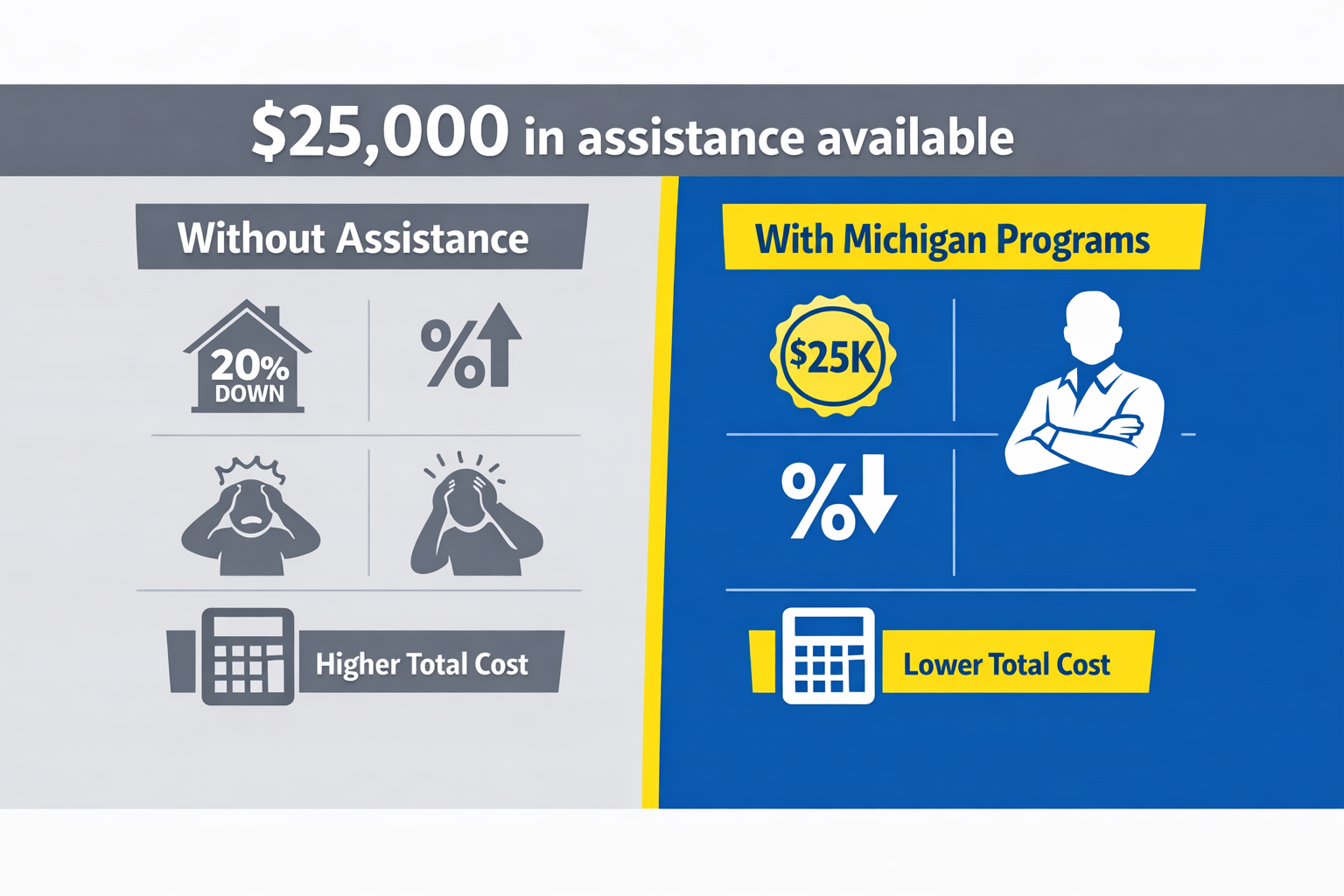
TL;DR: Michigan first time home buyers can access up to $25,000 in down payment assistance through state and local programs, plus below-market mortgage rates through MSHDA. Understanding which programs you qualify for and how to combine them strategically can save you tens of thousands of dollars on your home purchase.
Why Michigan First Time Home Buyer Programs Matter More Than Ever
Let me be direct with you. The Michigan housing market has changed dramatically. Median home prices have climbed over 8% in the past year alone, and if you are shopping in Grand Rapids, Ann Arbor, or the Detroit suburbs, you are competing against buyers who have been building equity for years.
But here is what most first time buyers miss: the Michigan State Housing Development Authority (MSHDA) and various local programs have responded to these challenges by expanding assistance options. The problem is not that help does not exist. The problem is that most buyers never learn about these programs until after they have already committed to a more expensive path.
I work with first time buyers every day who come to me frustrated, convinced they need 20% down or perfect credit to buy a home. That is simply not true in Michigan. What you need is the right information and a clear strategy.
The MI Home Loan: Your Foundation for Affordable Homeownership
The MI Home Loan program through MSHDA should be your starting point. This is a 30-year fixed-rate mortgage available through participating lenders across the state, and it comes with several advantages that conventional loans cannot match.
How the MI Home Loan Works
The MI Home Loan can be structured as a conventional, FHA, VA, or USDA loan depending on your situation. What makes it different is the combination of competitive rates and access to down payment assistance that you cannot get with standard mortgage products.
Key Requirements:
Household income must fall below area-specific limits (these vary by family size and where you are buying)
Purchase price cannot exceed $224,500 statewide
Minimum credit score of 640
Must be a first time buyer (or buying in a targeted area if you have owned before)
Now, I know what you might be thinking. A $224,500 price limit sounds restrictive, especially if you are looking in more competitive markets. You are right to consider that. But here is the reality: this limit still covers a significant portion of available homes in Michigan, particularly in areas like Lansing, Flint, Saginaw, and many suburban communities around Detroit.
For buyers in Grand Rapids or other higher-priced markets, you will want to explore the city-specific programs I will cover later, which can work alongside or independently of the MI Home Loan.
Down Payment Assistance: Where the Real Savings Happen
This is where Michigan truly stands out. The state offers multiple down payment assistance programs that can dramatically reduce your upfront costs.
MI 10K Down Payment Assistance Program
The MI 10K DPA program provides up to $10,000 as a zero-interest loan. This money can cover your down payment, closing costs, and prepaid expenses like homeowners insurance and property taxes that are collected at closing.
The best part? There are no monthly payments on this loan. You only repay it when you sell the home, refinance, or pay off your mortgage. For most first time buyers, that means you could have access to $10,000 in assistance for 10, 20, or even 30 years without making a single payment on it.
To qualify, you need to be approved for an MI Home Loan through a participating lender. This is not a standalone program, but rather an enhancement to the MI Home Loan that makes it even more powerful.
City-Specific Programs That Can Stack Your Savings
Beyond the statewide options, several Michigan cities offer their own assistance programs. These can sometimes be combined with state programs, creating multiple layers of support.
Detroit Metro Area: National Faith Down Payment Assistance
First time buyers in the Detroit metro area can access up to $13,999 through National Faith Homebuyers. This comes as a zero-interest loan that is completely forgivable after five years.
Eligibility requirements:
Property must be in an eligible city within the metro Detroit area
Purchase price cannot exceed $218,000
Household income cannot exceed 80% of the Area Median Income
Must complete HUD-approved homebuyer education
Cannot have more than $20,000 in liquid assets
The five-year forgiveness feature is key here. If you stay in the home as your primary residence for five years, you never have to repay a penny of that assistance.
Grand Rapids: Homebuyer Assistance Fund
Grand Rapids offers up to $7,500 through its Homebuyer Assistance Fund. Like the National Faith program, this is a zero-interest loan that is forgiven after five years of occupancy.
To qualify:
Income must fall within program limits (varies by household size)
Must occupy the home as your primary residence for at least five years
Purchase price must be at or below HUD-established limits
Must complete an approved homebuyer education course
Cannot have more than $10,000 in cash assets
For Grand Rapids buyers, this program can be combined with state-level assistance in some cases, potentially giving you access to over $17,000 in total down payment help.
Federal Loan Programs Available to Michigan Buyers
Beyond Michigan-specific programs, you have access to several federal loan options that can make homeownership more accessible.
FHA Loans
FHA loans remain one of the most popular options for first time buyers because of their flexible requirements. You can qualify with a credit score as low as 580 and a down payment of just 3.5%. If your credit score is between 500 and 579, you can still qualify with 10% down.
The trade-off is mortgage insurance. FHA loans require both an upfront mortgage insurance premium and ongoing monthly mortgage insurance that lasts for the life of the loan in most cases. For many buyers, this is a worthwhile trade-off to get into a home sooner.
VA Loans
If you are an active-duty service member, veteran, or surviving spouse, VA loans offer some of the best terms available anywhere. No down payment required, no private mortgage insurance, and typically lower interest rates than conventional loans.
Michigan has a significant veteran population, and I consistently see VA loans provide the most affordable path to homeownership for those who qualify.
USDA Loans
USDA loans require no down payment and offer competitive rates, but you must buy in a designated rural area. The definition of "rural" is broader than you might expect. Many communities in northern Michigan, the Upper Peninsula, and even some areas within commuting distance of major cities qualify.
HomeReady and Home Possible
These programs from Fannie Mae and Freddie Mac require just 3% down and have more flexible income requirements than standard conventional loans. They are specifically designed for first time buyers and can be a good option if you do not qualify for state programs or prefer a conventional loan structure.
The Mortgage Credit Certificate: A Tax Advantage Worth Knowing
Michigan offers a Mortgage Credit Certificate (MCC) that provides a federal tax credit equal to 20% of your annual mortgage interest, up to $2,000 per year.
Here is how the math works: If you pay $12,000 in mortgage interest in a year, you would receive a $2,000 tax credit. That is not a deduction. It is a dollar-for-dollar reduction in your federal tax liability.
Over a 30-year mortgage, that could add up to $60,000 in tax savings.
Important limitation: The MCC cannot be combined with MI Home Loans or FHA 203(k) rehabilitation loans. You will need to weigh whether the MCC or the MI Home Loan with down payment assistance provides better overall value for your situation.
How to Determine Which Programs You Qualify For
With so many options available, figuring out which programs fit your situation can feel overwhelming. Here is a practical framework for narrowing down your choices.
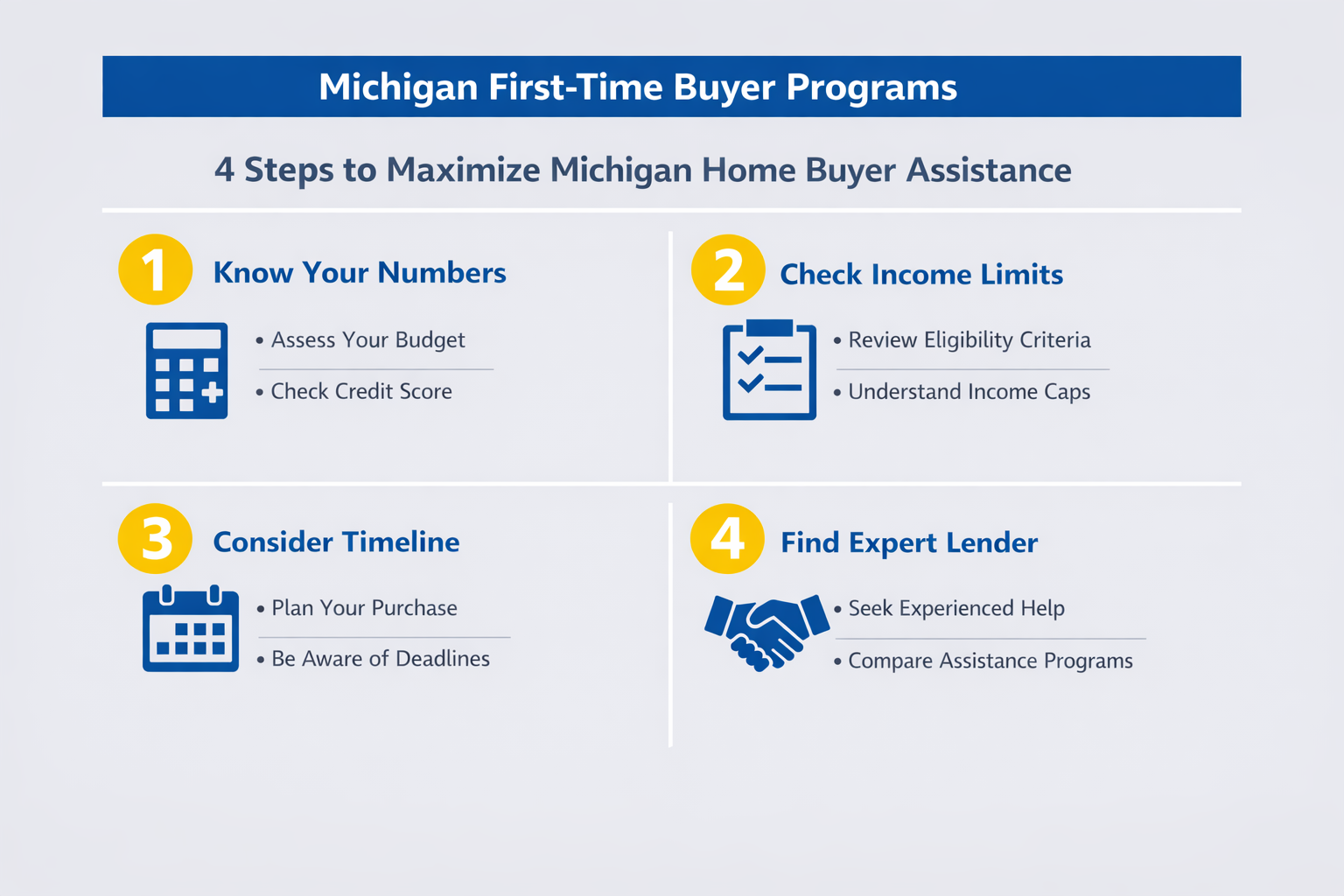
Step 1: Know Your Numbers
Before exploring any program, you need clarity on three things:
Your household income (gross annual income for everyone who will be on the loan)
Your credit score (you can get a free estimate from many online sources, but a lender will pull your official score)
Your available savings for down payment and closing costs
Step 2: Check Income Limits
Most assistance programs have income limits that vary by county and household size. MSHDA publishes these limits on their website, and they are updated periodically. Do not assume you make too much to qualify. Many middle-income buyers are surprised to find they fall within the limits.
Step 3: Consider Your Timeline
Some programs, like NACA, require extensive preparation and can take several months to complete. Others, like the MI Home Loan with DPA, can move on a more traditional timeline. Be realistic about when you want to buy and choose programs that align with that goal.
Step 4: Work With a Knowledgeable Lender
This is where I have to be direct with you. Not every lender participates in every program, and not every loan officer understands how to maximize these benefits for you. Working with someone who specializes in first time buyer programs in Michigan can make the difference between leaving money on the table and getting every dollar of assistance you deserve.
Common Mistakes First Time Buyers Make With Assistance Programs
After working with hundreds of first time buyers, I have seen the same mistakes repeated over and over. Here is what to avoid.
Mistake 1: Assuming You Do Not Qualify
Too many buyers eliminate themselves from programs before even checking the requirements. Income limits are often higher than people expect, and credit score requirements are more flexible than conventional wisdom suggests.
Mistake 2: Not Combining Programs Strategically
Some programs can be stacked together, while others cannot. Understanding which combinations are allowed and which provide the best overall value requires careful analysis. Do not settle for one program when you might qualify for multiple layers of assistance.
Mistake 3: Waiting for Perfect Conditions
I understand the temptation to wait for rates to drop or prices to stabilize. But here is the reality: while you wait, you are paying rent that builds no equity, and home prices in Michigan have consistently trended upward over time. The assistance programs available today may not exist in the same form next year.
Mistake 4: Skipping Homebuyer Education
Many assistance programs require completion of a homebuyer education course. Some buyers view this as a hurdle to clear rather than a valuable resource. The truth is, these courses can help you avoid costly mistakes and feel more confident throughout the buying process.
Your Next Steps Toward Homeownership
If you have read this far, you are serious about buying your first home in Michigan. That puts you ahead of most people who dream about homeownership but never take action.
Here is what I recommend as your next steps:
First, get clear on your financial picture. Pull your credit reports, calculate your household income, and tally up your available savings.
Second, research the specific programs available in your target area. If you are buying in Detroit, Grand Rapids, or another city with local programs, those may offer additional benefits beyond the state options.
Third, connect with a lender who specializes in first time buyer programs. This is not the time to work with someone who treats you like just another transaction. You need a partner who will take the time to understand your situation and guide you toward the best combination of programs for your needs.
If you want help navigating these options and creating a clear path to homeownership, I would be happy to talk through your situation. You can schedule a free practice purchase consultation at michiganmortgagesolutions.com/home-purchase-consultation or call us directly at (248) 963-1894.
Buying your first home in Michigan is absolutely achievable, even in today's market. The programs exist. The assistance is real. What you need now is a clear strategy and someone in your corner who knows how to make it happen.