




Buy a House with Student Loans Michigan: 2026 Guide
Buying a home while carrying student loan debt feels like trying to climb a mountain with a backpack full of bricks. But here is the truth that most people overlook: student loans do not automatically disqualify you from homeownership in Michigan.
TL;DR: You can absolutely buy a house in Michigan with student loans by understanding how lenders calculate your debt-to-income ratio and taking advantage of income-based repayment plans that lower your monthly payment obligations. The key is working with a mortgage professional who knows how to structure your application for approval.
The Reality of Student Loan Debt in Michigan
If you are a Michigan resident with student loans wondering whether homeownership is even possible, you are not alone. The average college graduate carries roughly $34,000 in student loan debt, and that number continues to climb. For someone like you who has worked hard to build a career, possibly in Grand Rapids, Detroit, or Ann Arbor, watching home prices rise while your student loan balance barely budges can feel defeating.
But here is what I need you to understand: the mortgage industry has evolved significantly in how it treats student loan debt. The old rules that made it nearly impossible to qualify are gone. New guidelines give you real pathways to homeownership that did not exist just a few years ago.
How Lenders Actually Calculate Your Student Loan Payment
This is where most people get confused, and where having the right information makes all the difference.
Previously, lenders were required to use 1% of your total student loan balance as your monthly payment when calculating your debt-to-income ratio. Using that $34,000 average, lenders would count $340 per month against you regardless of what you actually paid.
That rule changed everything for borrowers on income-driven repayment plans.
The Income-Based Repayment Advantage
Today, if you are enrolled in an income-based repayment plan, lenders can use your actual monthly payment amount instead of the 1% calculation. This single change has opened the door for thousands of Michigan residents who were previously locked out of the housing market.
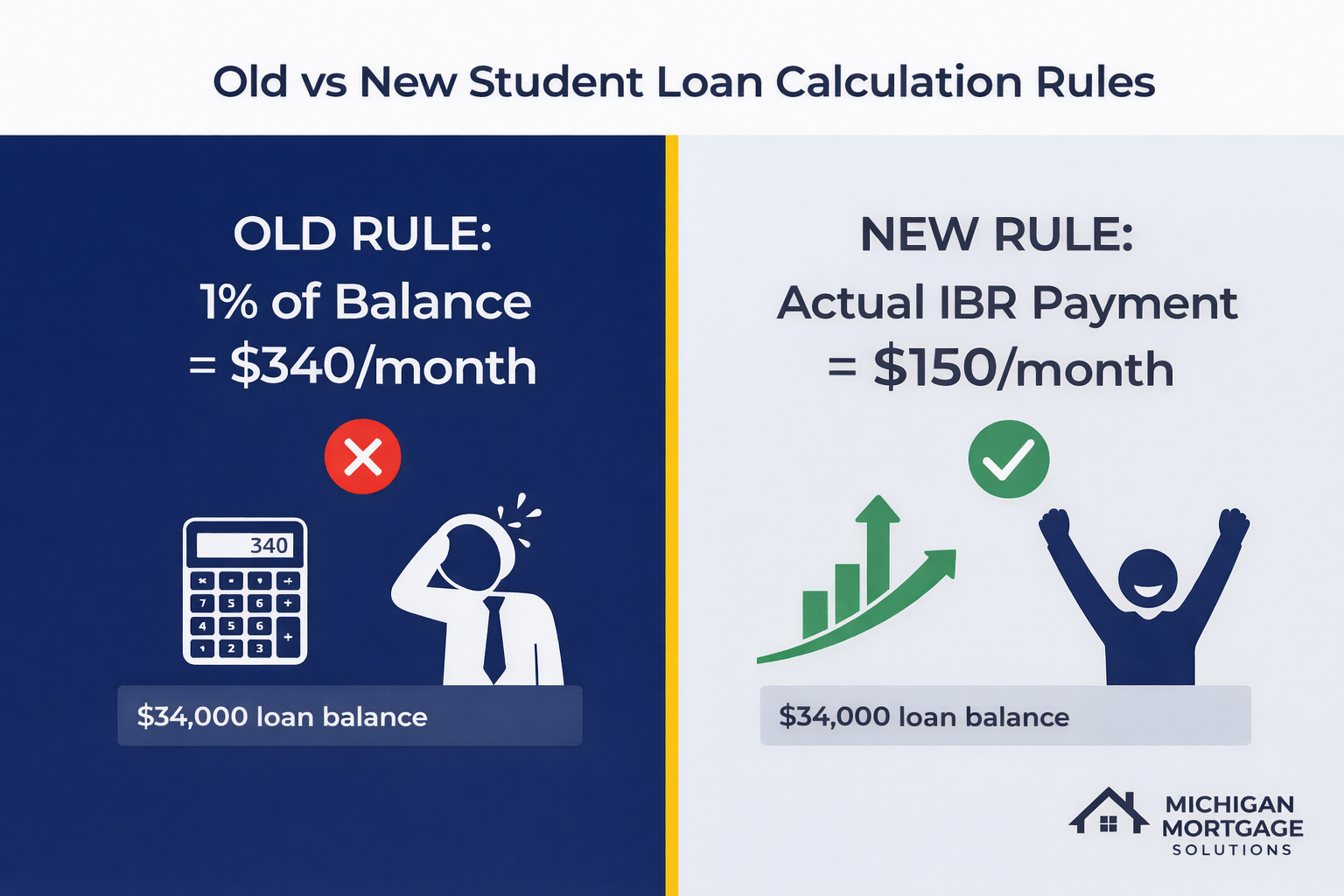
Let me break this down with real numbers:
Old calculation: $34,000 student loan balance × 1% = $340 monthly payment used for qualification
New calculation: Your actual income-based payment, which could be $150, $200, or even $0 depending on your income and family size
That difference of $0 to $340 per month in your debt-to-income calculation can mean the difference between approval and denial.
Types of Mortgage Programs Available to Michigan Borrowers with Student Loans
Understanding your options is critical. Not all loan programs treat student debt the same way.
Conventional Loans (Fannie Mae and Freddie Mac)
Conventional loans now allow lenders to use your income-based repayment amount when qualifying you. If your payment is $0 under an income-driven plan, lenders will typically use 0.5% of your outstanding balance or $10, whichever is greater.
FHA Loans
FHA loans are popular with first-time buyers in Michigan because of their lower down payment requirements. For student loans, FHA allows lenders to use:
The payment amount reported on your credit report
0.5% of the outstanding balance if the payment shows as $0 or is deferred
VA Loans
If you are a veteran or active-duty service member in Michigan, VA loans offer some of the most flexible guidelines for student loan debt. Lenders can use your actual payment amount, making this an excellent option for qualifying borrowers.
USDA Loans
For buyers looking at properties in rural Michigan areas, USDA loans allow the use of income-based repayment amounts, opening up affordable homeownership in communities outside major metro areas.
Steps to Prepare for Buying a Home with Student Loans
Getting approved requires strategy. Here is how to position yourself for success.
Step 1: Know Your Numbers
Pull your credit report and document your exact student loan balances and monthly payments. If you are on an income-driven repayment plan, gather documentation showing your current payment amount.
Step 2: Optimize Your Repayment Plan
If you are not already on an income-based repayment plan and your standard payment is hurting your debt-to-income ratio, consider switching. Plans like Income-Based Repayment (IBR), Pay As You Earn (PAYE), and Revised Pay As You Earn (REPAYE) can significantly reduce your monthly obligation.
Step 3: Avoid New Debt
In the months leading up to your home purchase, avoid taking on new credit card debt, car loans, or other obligations. Every dollar of monthly debt reduces your purchasing power.
Step 4: Build Your Down Payment
While low down payment options exist, having more money saved gives you flexibility. Programs like Conventional 97 require just 3% down, and FHA loans require 3.5%. Some Michigan down payment assistance programs can help bridge the gap.
Step 5: Get Pre-Approved Early
A pre-approval from a knowledgeable lender tells you exactly where you stand. It identifies potential issues before you start house hunting and gives you credibility with sellers in competitive Michigan markets.
The Cash-Out Refinance Strategy for Existing Homeowners
If you already own a home in Michigan and want to eliminate your student loan debt, a cash-out refinance might make sense. This strategy allows you to:
Tap into your home equity to pay off student loans
Potentially convert higher-interest student debt to a lower mortgage rate
Simplify your monthly payments into one obligation
Possibly reduce your overall monthly debt payments
This approach works best for homeowners with at least 20% equity in their property. The math needs to work in your favor, so run the numbers carefully or work with a mortgage professional who can analyze your specific situation.
Common Mistakes to Avoid
I see Michigan buyers make these errors repeatedly. Learn from their missteps.
Assuming you cannot qualify: Too many people never even apply because they assume their student loans disqualify them. Get a professional assessment before counting yourself out.
Not shopping for the right lender: Some lenders are more experienced with student loan situations than others. Work with someone who understands the nuances of these guidelines.
Ignoring your credit score: Student loans affect your credit utilization and payment history. Make sure you are making on-time payments and addressing any credit issues before applying.
Waiting for the perfect moment: Housing prices in Michigan markets like Grand Rapids, Ann Arbor, and the Detroit suburbs continue to rise. Waiting until your student loans are paid off could cost you years of equity building.
Your Path Forward
Buying a house with student loans in Michigan is not just possible. It is happening every day for borrowers who understand the rules and work with the right professionals.
The key is getting accurate information about your specific situation. Generic advice from the internet only takes you so far. Your income, your loan balances, your repayment plan, and your target purchase price all factor into whether you can qualify and for how much.
If you are ready to stop wondering and start knowing where you stand, reach out for a Free Practice Purchase consultation. This no-obligation conversation will give you clarity on your options and a roadmap to homeownership.
Contact Michigan Mortgage Solutions today:
Visit: https://michiganmortgagesolutions.com/home-purchase-consultation
Call: (248) 963-1894
Your student loans do not have to keep you renting forever. Let us figure out your path to owning a home in Michigan.