





Hard Money vs DSCR Loans for Fix-and-Flip Investors
If you are flipping houses and trying to figure out which loan makes the most sense for your next deal, you are not alone. This is one of the most common questions I get from investors who are scaling their portfolios and want to make smarter financing decisions.
TL;DR: Hard money loans are the go-to choice for fix-and-flip investors who need fast funding and short-term flexibility, while DSCR loans are better suited for buy-and-hold strategies where rental income covers the mortgage. Choosing the right loan depends entirely on your exit strategy and how quickly you plan to sell or refinance.
Let me break this down in a way that actually helps you make a confident decision on your next project.
Understanding the Core Difference
Before we get into the weeds, let me give you the fundamental distinction between these two loan types.
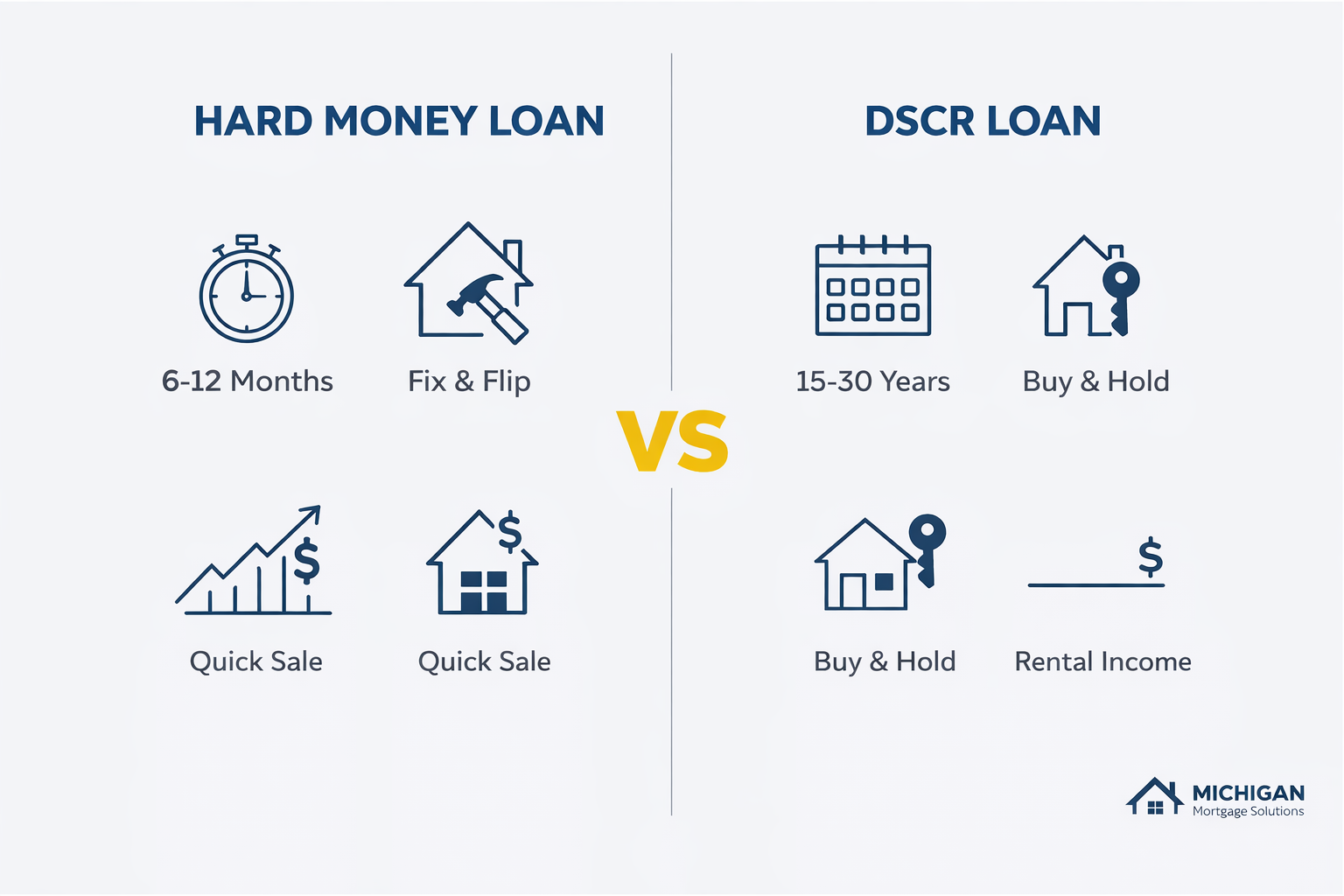
Hard money loans are short-term, asset-based loans designed for speed. Lenders care more about the property value and your deal than your personal income or tax returns. These loans typically run 6 to 18 months and come with higher interest rates because they are built for quick turnarounds.
DSCR loans (Debt Service Coverage Ratio loans) are long-term financing tools that qualify you based on the rental income a property generates. If the rent covers the mortgage payment, you can qualify without showing pay stubs, W-2s, or tax returns. These loans are structured for 15 to 30 year terms with lower rates than hard money.
Here is the simple way to think about it: hard money is for the flip, DSCR is for the hold.
Why Hard Money Wins for Fix-and-Flip Projects
If your strategy is to buy a distressed property, renovate it, and sell it within 12 months, hard money is almost always the right tool for the job. Here is why.
Speed to Close
When you find a deal that makes sense, you cannot afford to wait 30 to 45 days for traditional underwriting. Hard money lenders can fund deals in as little as 7 to 14 days. That speed gives you a competitive edge when you are bidding against other investors or trying to lock up off-market properties.
Flexible Qualification
Hard money lenders focus on the asset, not your personal financial situation. They want to know the after-repair value (ARV) of the property and whether your numbers make sense. This is a huge advantage if you are self-employed, have inconsistent income, or simply do not want to hand over two years of tax returns.
Renovation Funding Built In
Most hard money loans include a rehab draw structure. That means you can finance both the purchase and the renovation costs in a single loan. As you complete phases of the project, you draw funds to pay contractors and cover materials. This keeps your cash working for you instead of sitting tied up in a property.
Short-Term by Design
Hard money loans are meant to be paid off quickly. You are not stuck with a 30-year commitment. You flip the property, pay off the loan, and move on to the next deal. The higher interest rate is a non-issue when you are only holding the loan for 6 to 9 months.

When DSCR Loans Make More Sense
Now, if your plan is to buy a property, fix it up, rent it out, and hold it for cash flow, the conversation changes completely.
Lower Interest Rates for Long-Term Holds
DSCR loans typically come with interest rates between 6 and 10 percent, compared to 10 to 14 percent on hard money. Over a 30-year term, that difference adds up to tens of thousands of dollars in savings. If you are holding a rental property for the long haul, you want the lowest cost of capital you can get.
No Personal Income Verification
This is the feature that makes DSCR loans so attractive to investors. The lender qualifies the loan based on the property's rental income, not your W-2 or tax returns. If the rent covers the mortgage payment (typically at a 1.0 DSCR or higher), you can qualify. This is a game-changer for self-employed investors or anyone who writes off a lot of income on their taxes.
Predictable Monthly Payments
With a fixed-rate DSCR loan, you know exactly what your payment will be for the life of the loan. That predictability makes it easier to project cash flow and build a sustainable rental portfolio.
The BRRRR Strategy: Where Both Loans Work Together
Here is where things get interesting. If you are using the BRRRR method (Buy, Rehab, Rent, Refinance, Repeat), you actually need both loan types working in sequence.
Step 1: Use a hard money loan or a Fix and Flip Loan to purchase and renovate the property quickly.
Step 2: Complete the rehab and get a tenant in place.
Step 3: Refinance into a DSCR loan or Rental Loan to lock in long-term financing based on the property's rental income.
Step 4: Pull your cash out and repeat the process on the next deal.
This strategy lets you leverage the speed and flexibility of hard money on the front end while transitioning into the stability and lower cost of a DSCR loan once the property is stabilized. It is the best of both worlds.
Key Factors to Consider Before You Choose
Let me give you a quick framework for deciding which loan fits your next deal.
What Is Your Exit Strategy?
If you are selling the property within 12 months, hard money is the clear choice. If you are holding it as a rental, DSCR is the better fit. Your exit strategy should drive your financing decision, not the other way around.
How Fast Do You Need to Close?
If you are competing for a deal and need to close in two weeks, hard money is your only realistic option. DSCR loans take longer to underwrite because lenders need to verify rental income and property condition.
What Is Your Cash Position?
Hard money loans often require 10 to 20 percent down plus closing costs. DSCR loans may require similar down payments but offer lower monthly carrying costs. Make sure you have enough liquidity to cover the down payment, rehab costs, and a few months of holding costs in case the project takes longer than expected.
Are You Building a Portfolio or Flipping for Profit?
If your goal is to build long-term wealth through rental properties, DSCR loans help you scale without being limited by your personal income. If you are focused on flipping for short-term profit, hard money keeps your capital moving and your deals closing.
Common Mistakes I See Investors Make
Let me save you some headaches by pointing out a few mistakes I see all the time.
Using Hard Money for a Long-Term Hold
I have seen investors close on a property with hard money, finish the rehab, and then struggle to refinance before the loan matures. If you are planning to hold a property, make sure you have a clear path to permanent financing before you close on the hard money loan.
Ignoring the True Cost of Capital
Hard money rates look expensive on paper, but the real cost depends on how long you hold the loan. A 12 percent rate on a 6-month flip is a lot cheaper than a 7 percent rate on a 30-year loan you never needed. Always calculate the total cost of the loan based on your actual timeline.
Not Having a Backup Plan
Deals go sideways. Rehabs take longer than expected. Markets shift. Make sure you have reserves and a backup exit strategy in case your original plan does not work out.
How Michigan Mortgage Solutions Can Help
At Michigan Mortgage Solutions, we work with fix-and-flip investors and portfolio builders every day. We offer Fix and Flip Loans designed for speed and flexibility, along with Rental Loans and DSCR options for investors who want to hold properties long-term.
Whether you are closing your first flip or scaling to your tenth rental, we can help you structure the right financing for your strategy. We understand the numbers, the timelines, and the challenges that come with building a real estate portfolio.
If you want to talk through your next deal and figure out which loan makes the most sense, schedule a Free Investor Consultation at michiganmortgagesolutions.com/investor-consultation or call us directly at (248) 963-1894.
Final Thoughts
The question of hard money vs DSCR loans is not about which one is better in a vacuum. It is about which one fits your strategy, your timeline, and your goals.
If you are flipping, hard money gives you the speed and flexibility to compete and close deals fast. If you are holding, DSCR loans give you the long-term stability and lower rates you need to build cash flow.
And if you are running the BRRRR strategy, you need both tools in your toolbox.
The investors who win are the ones who understand their financing options and use the right tool for the right job. Now you have the information to make that call with confidence.