




Cash-Out Refinance Michigan: When to Use Home Equity
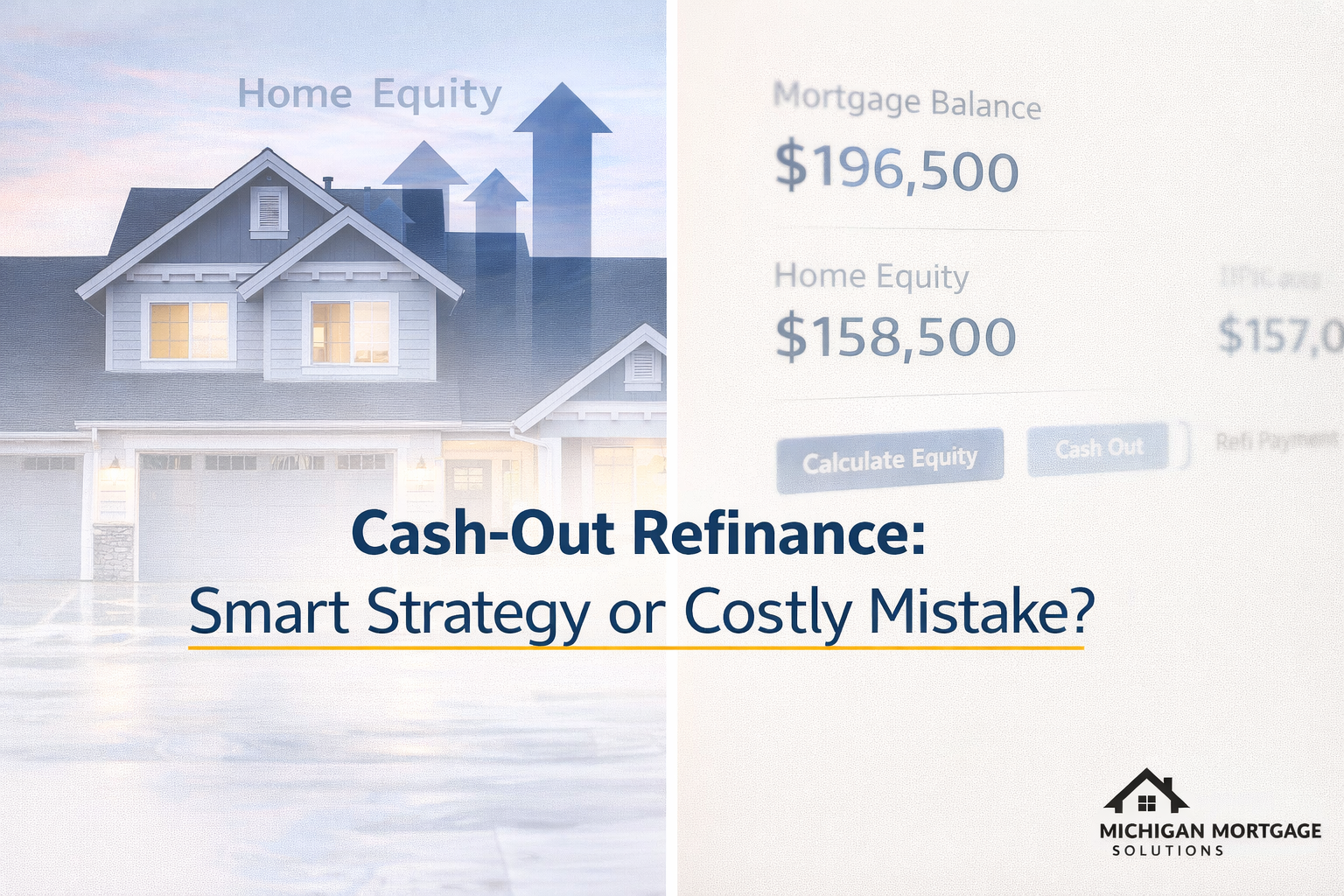
If you have been watching your home equity grow over the past few years, you have probably wondered whether tapping into it makes sense. A cash-out refinance can be a powerful financial tool, but it can also be a costly misstep if the timing or purpose is wrong.
TL;DR: A cash-out refinance in Michigan can help you consolidate debt, fund home improvements, or cover major expenses at a lower interest rate than most alternatives. However, it becomes a mistake when you use the funds for depreciating assets, ignore the closing costs, or extend your loan term without a clear financial benefit.
What Is a Cash-Out Refinance and How Does It Work?
A cash-out refinance replaces your current mortgage with a new, larger loan. The difference between what you owe and the new loan amount comes back to you as cash at closing.
Here is a straightforward example. Say your home is worth $300,000 and you owe $180,000 on your mortgage. You have $120,000 in equity. With a cash-out refinance, you might take out a new loan for $240,000. After paying off your existing $180,000 balance, you walk away with $60,000 in cash, minus closing costs.
That cash becomes part of your new mortgage. You pay it back over time, typically at a lower interest rate than credit cards, personal loans, or home equity lines of credit.
For Michigan homeowners like you who have built equity steadily over the years, this can be an attractive option. But the question is not whether you can access that equity. The question is whether you should.
When a Cash-Out Refinance Makes Sense
Consolidating High-Interest Debt
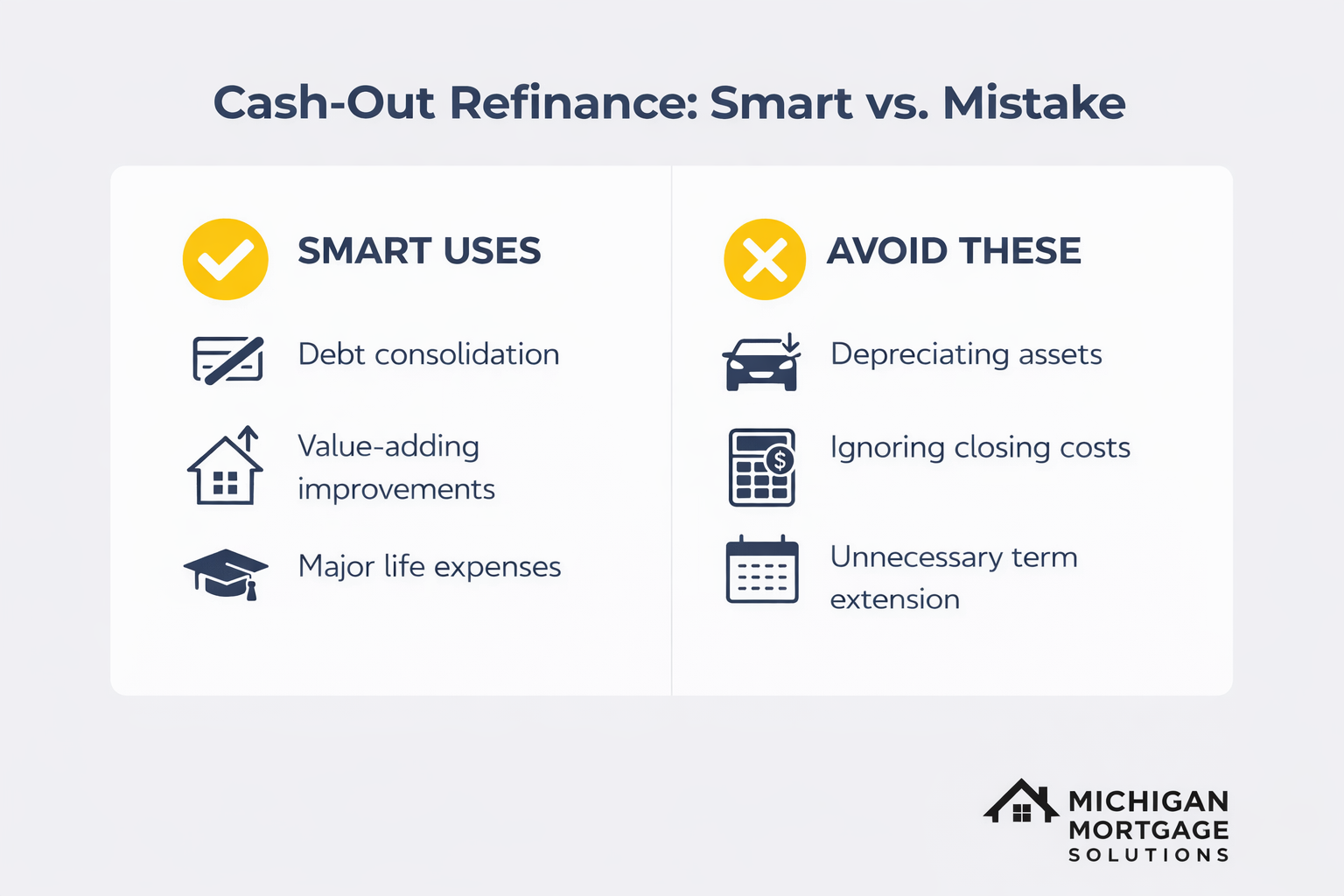
If you are carrying credit card balances at 18 to 24 percent interest, using home equity to pay them off can save you thousands. Mortgage rates, even in today's environment, are significantly lower than revolving credit rates.
This strategy works best when you commit to not running up new debt after the consolidation. The goal is to reduce your total interest burden and simplify your monthly payments, not to free up credit cards for more spending.
Funding Home Improvements That Add Value
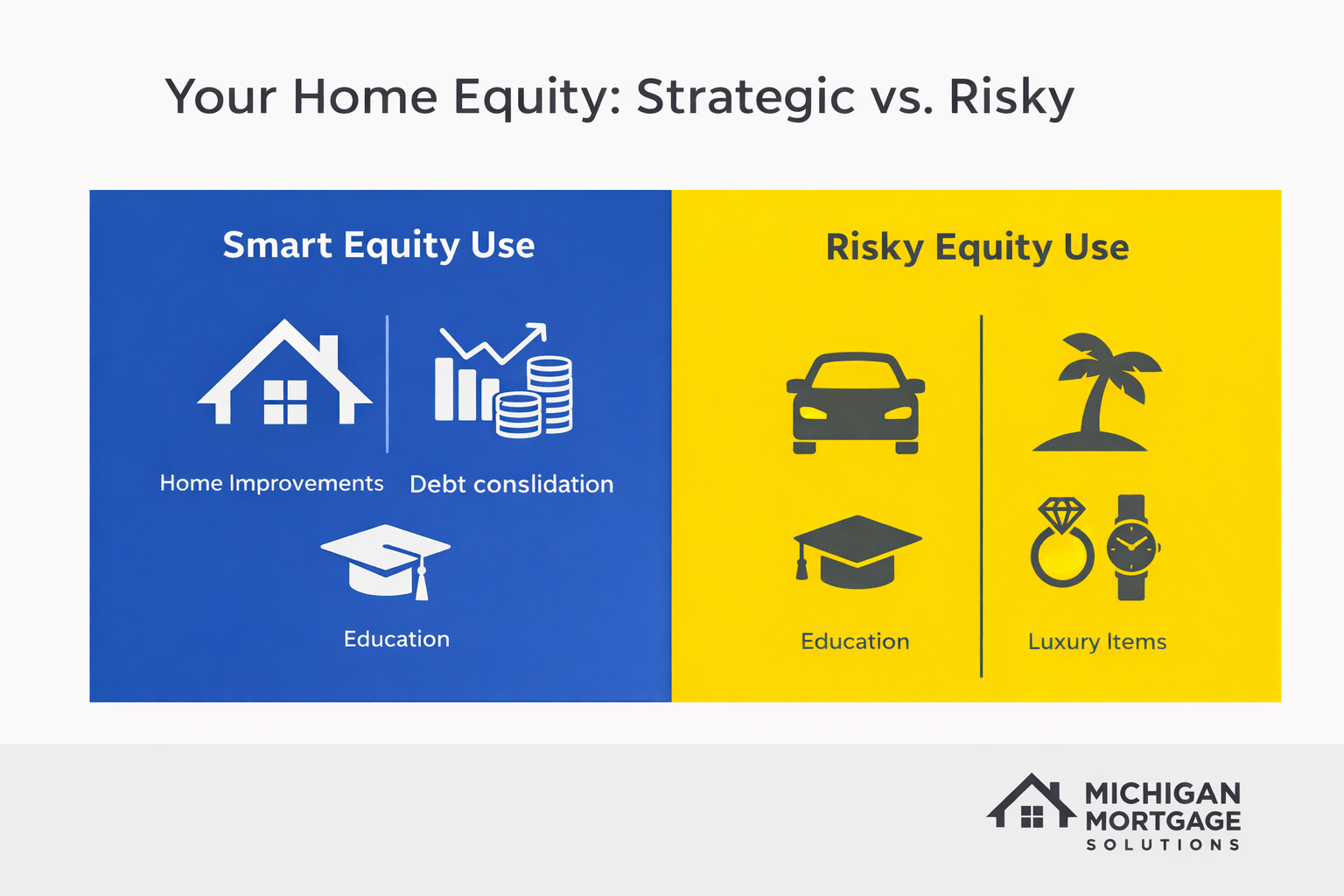
Renovations that increase your home's value or functionality can be a smart use of cash-out funds. Think kitchen remodels, bathroom upgrades, or finishing a basement. These projects often return a portion of their cost in increased home value.
For Michigan homeowners in areas like Oakland County or the suburbs of Detroit, strategic improvements can also make your home more competitive if you decide to sell down the road.
Covering Major Life Expenses
Sometimes life throws you a curveball. Medical bills, education costs, or helping a family member through a tough time can strain your finances. A cash-out refinance can provide a lump sum at a manageable interest rate, giving you breathing room without resorting to high-cost borrowing.
The key here is intentionality. You are not using your home as an ATM. You are making a calculated decision to leverage an asset you have built over time.
When a Cash-Out Refinance Is a Mistake
Using the Funds for Depreciating Assets
Taking equity out of your home to buy a boat, finance a vacation, or purchase a new car is almost always a bad idea. You are converting a long-term asset into a short-term expense and paying interest on it for decades.
Your home equity is not free money. It is wealth you have accumulated. Spending it on things that lose value the moment you buy them erodes your financial foundation.
Ignoring the True Cost of Closing
A cash-out refinance comes with closing costs, typically ranging from 2 to 5 percent of the loan amount. On a $240,000 loan, that could mean $4,800 to $12,000 in fees.
If you are not staying in the home long enough to recoup those costs through lower payments or debt savings, the refinance may not make financial sense. Calculate your break-even point before you commit.
Extending Your Loan Term Without a Plan
If you have been paying your mortgage for 10 years and you refinance into a new 30-year loan, you are resetting the clock. That means more years of payments and more total interest paid over the life of the loan.
This does not mean extending the term is always wrong. But you need to understand the trade-off. If your goal is to reduce monthly payments during a tight financial period, that may be worth it. If you are simply chasing a lower rate without considering the long-term cost, you could end up worse off.
Falling for Predatory Offers
Not every lender has your best interests in mind. Some will push you toward a cash-out refinance because it generates fees for them, not because it benefits you. Watch out for aggressive marketing, pressure tactics, or offers that seem too good to be true.
Work with a lender who takes the time to understand your goals, explains the numbers clearly, and helps you weigh the pros and cons honestly.
How to Decide If a Cash-Out Refinance Is Right for You
Start by asking yourself a few questions:
What will I use the funds for, and will that use improve my financial position?
Can I afford the new monthly payment comfortably?
How long do I plan to stay in this home?
What are the total costs, including closing fees and additional interest over time?
Am I confident in my home's current value and my ability to maintain equity?
If you can answer these questions with clarity and confidence, you are in a good position to make an informed decision.
Michigan-Specific Considerations
Michigan's housing market has seen steady appreciation in many areas, which means your equity may be higher than you realize. However, appraisals can vary, and local market conditions matter. A home in Grand Rapids may appraise differently than one in Lansing or the Detroit suburbs.
Before you move forward, get a realistic sense of your home's value. Talk to a local mortgage professional who understands the Michigan market and can help you run the numbers based on your specific situation.
The Bottom Line
A cash-out refinance is not inherently good or bad. It is a tool. Like any tool, its value depends on how you use it.
When used wisely, it can help you eliminate high-interest debt, invest in your home, or navigate a financial challenge with less stress. When used carelessly, it can drain your equity, extend your debt, and leave you worse off than before.
If you are considering a cash-out refinance in Michigan and want to make sure it is the right move for your situation, I am here to help. At Michigan Mortgage Solutions, we walk you through the numbers, answer your questions, and help you make a decision you feel confident about.
Ready to explore your options? Schedule a free refinance review at michiganmortgagesolutions.com/refinance-consultation or call us at (248) 963-1894. No pressure, just clarity.